Are you struggling to choose an upright vs spin bike for your home gym? This guide is here to help you make the most suitable choice.
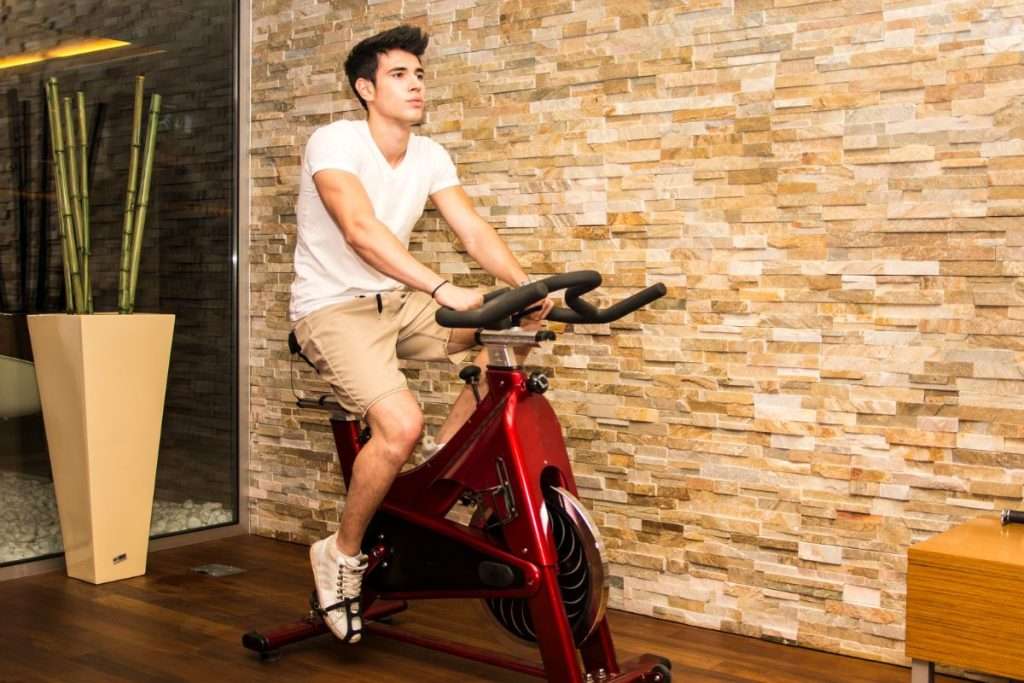
As a personal trainer, I can say that both types of bikes offer excellent workouts. However, each possesses its own set of pros and cons.
Identifying the features that matter the most to you when choosing the bike is essential. Having used these bikes, I can confirm firsthand that both excel in their domain.
So I made this comparison guide to help you understand the differences between these two types of bikes. And if you wish to gain a deeper understanding of their functionality, continue reading!
Table of Contents
- Upright Bike vs Spin Bike
- Upright Bike vs Spin Bike: The Winner
- Which indoor bike is best for YOU?
- What to do next?
Upright Bike vs Spin Bike
Type of exercise
An upright bike is also called an upright exercise bike or a stationary bike. It mirrors a traditional outdoor bicycle in design and body posture for indoor workout routines.
As the name suggests, it places the user in an upright sitting position. This type of indoor bike has a comfy saddle seat, front-set handlebars, and foot pedals directly beneath the body.
Cyclists rest their weight mostly on the sitting bones, hands, and feet while in motion. It is often preferred for its familiar bicycle-like feel and the way it engages major muscle groups during workouts.
They cater well to both leisurely usage and intense exercise that convert your normal bike into static exercise equipment.
A spin bike, or indoor cycling bike, is a specific variety of stationary workout bicycles meant for high-energy workouts, often a popular choice in group exercise classes.
Unlike conventional upright bikes, Spin bikes feature a significant flywheel connected to the pedals. It replicates the feeling of outdoor biking while also providing added resistance.
The term “Spinning” points to a concrete brand associated with exercise bikes and indoor cycling sessions, and not all indoor bikes can be rightly dubbed as spin bikes, despite the common misuse of the term.
Winner Type of Exercise Comparison
The type of exercise comparison is a draw, as it depends on your situation and goals.
Calories burned
Due to the resistance setting, spin bikes can burn more calories in a shorter time. But it completely depends on your intensity during the workout.
For illustration, a beginner might use lower resistance to focus on building stamina and muscle strength. while an experienced rider can increase the resistance level for enhanced outcomes.
Upright bikes also provide an effective calorie-burning workout, but you have to bike longer to experience the same amount of calorie burn.
A 30-minute exercise on an upright bike commonly results in about 300 calories burned. On the other hand, using a spin bike in a high-intensity mode for the same duration may result in burning up to 500 calories.
A study published in the National Library of Medicine compared how many calories people burned during 30 minutes of different types of exercise [1]. Nine active men participated.
When exercising on the resistance machine, the men burned the most calories and had the highest heart rates. They also felt they were working hardest during this exercise.
The high-intensity resistance workout on the machine proved to be the most effective in calorie burn and heart rate increases. This tells us that high-intensity resistance workouts can be a suitable choice, especially if you are busy and seeking efficient equipment.
Spin bikes are an excellent way to get your high-intensity workout. If you choose a spin bike, you can achieve better results in less time.
Winner Type of Calories Burned Comparison
The spin bike is the winner because it burns more calories than an upright bike.
Targeted muscles
Spin bike
Pedaling on a spin bike provides a competent, gentle-on-the-joints workout that encourages muscle tone and calorie burn.
It targets multiple muscle groups, including:
- Quadriceps or the “quads”: This set of four muscles extending from the hip joint to the knee joint along the front of the thigh. It supports leg extension and is a major contributor to the strength needed in cycling.
- Hamstrings: These are the prominent muscles at the reverse side of the thigh, extending from the glutes to the back of the knee. These muscles play a significant role in the downstroke and upstroke motions during spinning.
- Glutes: These are the muscles in your rear end, which are predominantly active during seated riding. Since these muscles are usually less active, particularly during long sitting hours, spinning exercises effectively activate and strengthen them.
- Calves: Located at the back of your lower leg, they serve an active part in spinning. It maintains the ankle’s stability and helps in the leg’s extending and folding movements
- Core muscles: Including the abdominal muscles and obliques. These muscles activate during upright exercises and intensive spin bike drills.
- Apart from these predominant muscles, spinning also involves accessory muscle groups like the back and upper arm muscles. These muscles assist in holding the body’s posture and support the upper body during cycling.
Upright bike
Upright bikes mainly involve the muscle groups located in the lower extremities, including:
- Quadriceps: The large muscles on the anterior-most part of your thighs engage when you initiate a downward pedal movement.
- Hamstrings: On the back side of your thighs, these muscles function in cycling.
- Calves: Positioned on the backside of your lower legs, these muscles actively participate in the pedal movement.
- Core muscles: Cycling, in general, draws upon your abdominal and back muscles, which work together to keep your body stabilized
- Lower body muscles: Upright bike workouts enhance your whole lower body, giving extra emphasis when using more challenging resistances.
A key point to include, as suggested by The Centers for Disease Control and Prevention (CDC) [1]. Every adult should aim to achieve 150 minutes of moderate-intensity exercise every week and muscle-strengthening activities at least two days each week.
Winner Targeted Muscles Comparison
The spin bike is a winner because it engages more muscle groups.
Versatility
If you desire a high-intensity, versatile workout, a spin bike may align with your needs. But, if comfort and data monitoring hold greater significance to you, you may find an upright bike more appropriate.
Both options deliver impressive cardio workouts, the ultimate choice depends on personal tastes
Spin bike
Spin bikes establish an effective replication of outdoor bike riding owing to their larger and weightier flywheel. Their versatility shines through by offering standing, seated, and hill-riding workout simulations.
Spin bikes often include a resistance dial allowing you to tweak your ride’s difficulty to replicate uphill climbs or sprints.
Yet, their standard layout usually requires more effort in a leaning-forward position. It potentially leads to discomfort over long durations of biking.
only a handful of spin bikes feature consoles for recording distance, speed, or heart rate. It is less appealing if you prefer to keep track of your performance data.
Upright bike
Upright bikes exhibit traits more similar to traditional road bicycles. Their addition of a cushioned saddle may offer you more comfort, particularly for longer workouts.
Most upright bikes feature electronic resistance controls and an informational console that tracks speed, distance, duration, and calories burned.
While they might not provide as aggressive a workout as spin bikes, upright bikes can still offer a strong cardio exercise. Sometimes, these bikes come with pre-set workouts that could spice up your cycling experience.
However, they fall short of replicating the intense riding simulations of a spin bike, such as standing on the pedals.
Winner Versatility Comparison
The spin bike is the winner due to its capacity to replicate standing, seated, and hill-riding workout activities.
Impact and intensity
Due to its design, the spin bike is more intense than the upright bike. It allows you to push yourself harder and faster than you would on an upright bike.
It mimics the outdoor cycling experience that typically includes intervals of intense cycling followed by lighter periods. However, prolonged exercise in a standing position can put excessive stress on your knee joints, potentially causing injuries.
While the upright bikes align better with moderate-intensity workouts, they can serve high-intensity workouts too. It is frequently preferred for continuous cardio and is widely used in calm workouts.
Spin and upright bikes are both designed for low-impact activities. They present a lesser burden on the joints than high-intensity workouts, like spin bikes, which are suitable if you have joint problems or injuries.
Winner Winner Impact and Intensity Comparison
The upright bike is the winner because you can still get a great workout while minimizing strain and high-intensity pressure on your joints.
Space
Upright bikes are generally smaller and require less room than spin bikes. It is your better choice if your workout area is somewhat restricted.
Upright bikes’ dimensions might vary slightly because of distinctions between different brands and models [2]. Typically, their dimensions can be summarized close to:
- Length: 35-48 inches (89-122 cm)
- Width: 18-26 inches (46-66 cm)
- Height: 25-30 inches (64-76 cm)
Spin bikes often stand a bit taller and are slimmer than upright bikes. They can make them a less-than-ideal choice if you have limited home gym space.
In my research on spin bike sizes, I noticed that the dimensions reported in the top 10 search results differ. It varies on the brand and model.
On average, the dimensions of spin bikes are roughly around:
- Length: 36-49 inches (91.44-124.46 cm)
- Width: 16-25 inches (40.64-63.5 cm)
- Height: 36-57 inches (91.44-144.78 cm)
Winner Space Comparison
The spin bike is the winner because it takes up less area than upright bikes and is suitable for narrow home gym spaces.
Price
The price of upright and spin bikes can vary depending on brand, features, and quality. On average, you can expect:
| Spin Bikes | $320-2600 |
| Upright Bikes | $150-3400 |
The prices given are a general guideline. These are based on my research and recent purchases for my home gym.
Winner Price Comparison
An upright bike is a price comparison winner, providing budget-friendly options to expensive spin bikes.
Upright Bike vs Spin Bike: The Winner
In this spin vs upright bike comparison, the spin bike is the winner regarding calories burned, target muscles, versatility, and space.
But for comfort and pricing, the upright bike claims the winning spot. Still, it’s important to remember that each bike has unique selling points.
The spin bike excels if you emphasize core muscle training and boost endurance, while the upright bike fits best if your interest lies in a more relaxed training routine at home.
But remember, you still have the opportunity to select both bikes like mine.
Which indoor bike is best for YOU?
Which indoor bike is better for losing weight?
A spin bike offers a higher calorie burn in a smaller timespan because of its resistance settings. So you can lose weight better than on an upright bike. Yet, this definitely varies based on the intensity incorporated in your workout.
Which indoor bike is best for beginners?
The best bike for beginners is the upright bike. It’s the most comfortable and least intimidating than a spin bike. It’s also good if you want something low-impact and gentle to your joints.
Which indoor bike is best for your budget?
An upright bike, starting at just $150, is the most wallet-friendly choice. Despite its lower cost options, you can seek out an upright bike furnished with a top-quality resistance system and console that guarantees a high-quality workout.
What to do next?
In this upright bike vs spin bike comparison, we’ve looked at the benefits and drawbacks of both types of exercise bikes. By now, you should have a clearer understanding of the bike type that suits you best.
I hope this article helped resolve some of your questions regarding upright vs spin bikes.
If you’re not yet convinced, experiment with both bikes to find the most suitable fit for your everyday life.
Try out both an upright and a spin bike at your neighborhood fitness center. Most gyms typically have both types as part of their equipment lineup, so arrange an appointment to visit your local gym to explore.
Check out the other blogs below for more fitness equipment comparisons, you may find some beneficial insights for your home gym.
16 Indoor Bikes For Heavy People (By Type)
The Best Spin Bike For a Short Person 2023
