
Are you wondering which type of elliptical is better? Is it the front-drive or the rear-drive?
Then, this front drive vs rear drive elliptical article is for you.
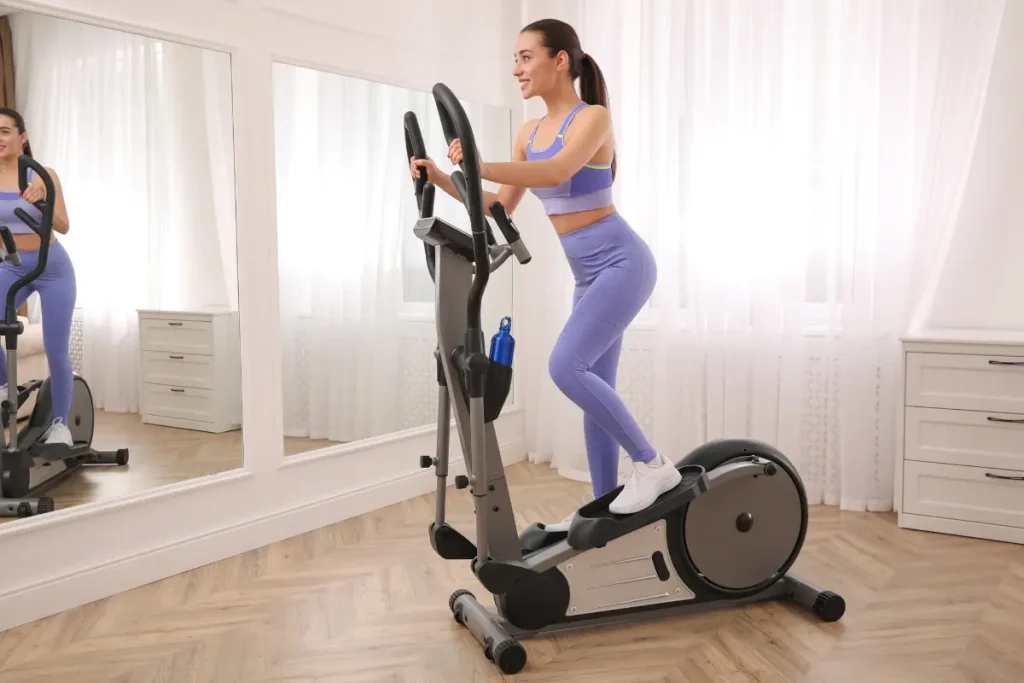
As a personal trainer, I have experience using both the front and rear drive elliptical. At first, they feel like they’re the same, but I realized they offer different workout experiences.
While I used the front drive elliptical more often, I still have a fair experience using the rear drive. Personally, I find the front drive elliptical challenging because the incline is more pronounced.
I like it as it suits my personality. I am always up for a challenge. But that’s for me.
Other people would want to enjoy a casual workout. Thus, they tend to pick an elliptical with a smoother stride, which rear drives can provide.
Rear drive ellipticals are best for light cardio exercises. On the other hand, front drives tend to focus on balance and strength.
Apart from the workout experience, there are also other differences between front and rear-drive ellipticals.
I covered all that in this article.
So, keep reading to learn more.
Front Drive Vs Rear Drive Elliptical Comparison
Flywheel and Workout Experience
Front drive ellipticals have flywheels in front, just below the handles and console. In contrast, rear drive units have their flywheel behind them.
But, does it matter?
Whether the flywheel is in front or behind you, the workout experience is the same.
That’s what I thought, too.
But after trying both types of ellipticals, I realized there are subtle differences.
Front drive ellipticals feel more like you’re walking uphill. The incline is more pronounced and feels less flat.
Due to this, the front drive elliptical works your muscles a bit harder. So if you want a higher-intensity workout, opt for a front drive elliptical.
Rear drive elliptical, on the other hand, provides a natural striding motion because it feels flat. This type of elliptical is great if you want a smooth and casual workout.
The rear drive elliptical does not put as much strain on your joints as its front drive counterpart. So I recommend this type for seniors.
Of course, the weight of the flywheel affects the workout experience too. The heavier the flywheel, the smoother the gliding motion.
Winner Flywheel and Workout Experience Comparison
This comparison is a draw, because it depends on your preference. Use the front drive if you prefer the uphill motion. You can also use the rear drive if you prefer the natural striding motion.
Resistance
The location of the flywheel does not affect the resistance of the elliptical. Resistance depends on how the manufacturer designed the machine.
So, whether the flywheel is in the front or rear, it does not matter if the amount of resistance is your priority.
Winner Resistance Comparison
This comparison is a draw. That’s because the location of the flywheel has no effect on the resistance.
Incline and Speed
Incline
The location of the flywheel does not affect the incline range.
However, there is a noticeable incline in the front drive, even if the incline is set to zero. It’s almost as if there is a fixed slight incline in the front drive.
If you use the front drive first and move to the rear drive after, you’ll notice the pedals are flatter on the rear drive elliptical.
Many people still prefer a rear-drive trainer because of its flat incline. It’s more natural in motion. Thus, it feels like running outdoors.
Speed
Both types of elliptical allow you to control your speed. The faster you pedal and the higher the resistance, the more challenging your workout is.
But the top speed of an elliptical is usually limited and might not match the same as a full-out sprint.
Remember this: your elliptical workout’s effectiveness is not only dependent on speed. It also depends on other factors, such as resistance, duration, and incline (if available).
Winner Incline and Speed Comparison
This comparison is a draw, since it depends on what your workout’s focus is.
Impact and Intensity
Front-drive and rear-drive elliptical trainers both offer low-impact workouts. Both types of elliptical provide effective cardiovascular exercise without putting too much strain on your joints and knees.
Ellipticals help provide a low-impact alternative to activities, like running. They also excel in providing cardiovascular exercise while minimizing stress on the joints.
Impact
Ellipticals are by nature, low-impact machines [1], which provide a gentler workout on the joints. Your feet stay in place with the pedal throughout the striding motion. So, you won’t experience sudden impacts like what happens during running or jogging exercises.
Front-drive ellipticals have a more vertical pedaling that resembles an actual stepping motion.
Meanwhile, rear-drive ellipticals tend to give a smoother and more horizontal path. This makes your exercise gentler on the joints.
In general, both front-drive and rear-drive ellipticals offer low-impact workouts. This makes them suitable for people seeking to avoid high-impact exercises like running or rope jumping.
Intensity
Factors such as resistance level, speed, and duration determine your workout’s intensity. Both kinds of ellipticals can offer the same intensity. That’s because the main factor controlling intensity is the resistance.
Your effort and control determine the intensity of your elliptical workout. You can adjust the intensity to tailor your workouts to your fitness level and goals.
Winner Impact and Intensity Comparison
This comparison is a draw, because both types of elliptical offer a low-impact exercise, and the intensity depends on how you use the machines.
Maintenance
Generally speaking, the required maintenance for both front and rear drive ellipticals is almost the same.
Take note that there are more components and moving parts in a front drive model. But sometimes, there can be some differences based on the design and construction of the elliptical.
Let’s take a look at the different aspects below:
- Cleaning: Both the front drive and rear drive ellipticals require the same level of cleaning. Parts like the frame, handles, console, and foot pedals may differ a little. Thus, it’s a draw between the two models.
- Lubrication: Some front-drive ellipticals need occasional lubrication of moving parts. Check the manual for guidance on intervals and the type of lubricant. With this, we can call a draw between the two types.
- Bolts and Screws: The number of bolts and screws differs between the two models. Hence, front drives may require frequent tightening. Rear drives may have lesser bolts and screws. Remember that the more parts an elliptical has, the more noise. Thus, the rear drive is a better option for a quieter workout.
- Repairs: The front drive elliptical has more smaller parts and components than the rear drive. Although front drives are easier to manufacture, they also need spare parts when they break down due to use. Thus, the rear drive wins here.
Winner Maintenance Comparison
In total, rear drive models are better when it comes to maintenance and repairs.
Size
Front drive ellipticals have a vertical design. These may not suit you if you have a high ceiling.
Front drives also have a shorter stride length due to its vertical pedal motion. This allows shorter people to make an easier stride.
Rear-drive ellipticals often have longer strides. Due to this, it requires more floor space. But a longer stride length means it suits taller people.
Always check the product’s details first. If possible, you can visit a fitness equipment store to measure the machines in person. This way, you can estimate how it fits your space before buying it.
Winner Size Comparison
The front drive elliptical is the winner, because it has a smaller footprint. But take note that your gym should have a good headspace.
Cost
The price of an elliptical depends on many factors. It also depends on the quality of the brand and its features. Generally, front drive models are cheaper than rear drives. Front drives value around $200 to $1000, while rear drives cost $300 to $2000.
In contrast, front drives may have an advantage on the cost. But in the long run, these tend to break down more often. Thus, you may also need to spend more money on repairs.
Meanwhile, a rear drive requires less maintenance and repair, thanks to its fewer components. Not only that, it costs a bit more than a front drive.
So, if you want a one-time cost with less repairs, then the rear drive is your best bet. But if you go for a cheap option, you can buy a front drive, but expect costs on spare parts and repairs.
Winner Cost Comparison
The rear drive elliptical is the winner, because it will save you more money in the long run. Although front drives are cheaper, you might end up spending more on repairs.
Front Drive Vs Rear Drive Elliptical: The Winner
After a complete review between the front drive and rear drive ellipticals based on their features, in most cases the rear drive elliptical is the winner here.
Considering all aspects, here’s my takeaways about what’s the better option.
- The rear drive elliptical costs more, but needs little to no maintenance and repair.
- The rear drive elliptical has a better flywheel placement.
- The rear drive elliptical has a more natural stride than a front drive.
The rear drive elliptical is far better in many respects. Yes, the front drive is more affordable. But it can become expensive to repair.
Which elliptical is best for YOU?
Which type of elliptical is best for beginners?
Both front-drive and rear-drive ellipticals are suitable for beginners.
If you want to put a good stress on your lower body, the front drive is a good choice.
But if you want a smooth stride with lesser intensity, the rear drive is your go-to machine.
Which type of elliptical is best for your budget?
Practically speaking, I’d rather save money in the long run than have expenses for repairs. The rear drive elliptical is the best for this.
The front drive elliptical can save you more money at first. If you use it less often, you won’t need to worry about spending for maintenance.
Which elliptical is best for your limited space?
The rear drive elliptical is the winner, because it will save you more money in the long run.
What is a center drive elliptical?
A center drive elliptical, as the name suggests, has the flywheel at the center of the machine. This means it’s right below you when you use the elliptical. Center drive ellipticals tend to have two flywheels, instead of one.
This means it’s way more compact than both the front and rear drive models. It’s great for a home gym with a small space.
Many people also prefer this model, as it gives less strain on your lower body.
What to do next?
While both the front and rear drive have some differences, remember that they are still both ellipticals. They offer many of the same benefits.
It’s just a matter of preference that will help you determine which type of elliptical suits you best.
As for me, I like the front drive better. How about you?
Let me know in the comments below!
Here are more elliptical articles that you might be interested in:
